


ERP Modernization: The Operational Imperative for Automotive Manufacturers
September 30, 2026
For automotive manufacturers, unpredictability has become a permanent part of doing business. With shifting consumer […]

As volatility pushes pressure from OEMs to Tier 1s and down through the supply chain, manufacturers need a disciplined approach to capital, costs and capacity – without sacrificing quality or delivery.
Manufacturing has always operated under pressure, but today’s volatility is coming from so many directions. With the barrage of shifting costs, changing sourcing economics, evolving customer expectations, fluctuating demand and an increasingly complex global supply chain, traditional approaches to planning are constantly being tested.
For Tier 1 suppliers in particular, the stress is intensifying. Caught between OEM expectations and their own supply base, many are absorbing costs they cannot immediately pass through to customers. In response, they are pushing some of that pressure downstream to Tier 2 and Tier 3 suppliers.
The result is a squeeze that can ripple throughout the supply chain.
When suppliers are asked to absorb higher costs, extend payment terms or make rapid changes to sourcing and production, the immediate objective may be to protect margins and preserve cash. But if that pressure becomes excessive, it can create new risks – from strained supplier relationships and reduced capacity to quality problems, delivery disruptions and ultimately loss of supply continuity.
The response, however, isn’t to freeze. It’s to become more strategic and deliberate about where and how to move.
Don’t let uncertainty drive indecision
When the market changes rapidly, the natural response is to wait for clarity. Manufacturers may delay capital investments, postpone footprint decisions or continually revise sourcing strategies in hopes that the next six months will provide a clearer picture. But volatility rarely follows a predictable timeline.
Constantly changing direction can be more damaging than making a decision based on the best information available today. Organizations can lose momentum, disrupt operations and consume valuable resources by simply reacting to each new development.
Manufacturers need to distinguish between changing the plan and changing the assumptions behind the plan.
The better approach is to establish a cautious, data-driven direction and stay the course – while maintaining the flexibility to pivot when the underlying business data indicates that a change is necessary. To do so, it requires confidence in the numbers.
Data is the foundation for knowing when to pivot
In an environment where conditions can change quickly, accurate master data and real-time visibility become strategic assets.
Manufacturers need to understand the economics of their operations at a granular level:
This knowledge provides a much clearer picture than simply looking at individual material or labor costs. Total landed cost, for example, has always been a critical consideration in sourcing decisions. Freight, labor, duties, capital requirements and other costs all contribute to the actual economics of where a product should be manufactured. As individual cost components fluctuate, the overall equation can change dramatically.
The same principle applies to footprint decisions.
A manufacturer shouldn’t move production simply because one cost has increased. It should understand the complete economic picture and determine whether the change creates a sustainable advantage.
That is how manufacturers avoid the yo-yo effect of making major strategic decisions every time the market sways.
Protect the fundamentals: quality, delivery and capital
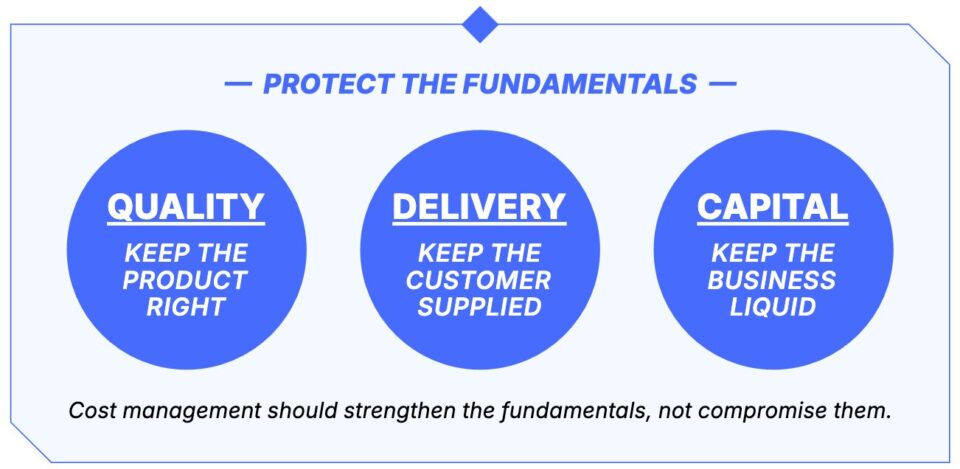
When margins are under pressure, it can be tempting to focus almost exclusively on profitability. But there are three fundamentals that manufacturers cannot afford to compromise: quality, delivery and cash.
Quality and delivery are what keeps a supplier in the game. A manufacturer may survive a period of lower profitability. It is much harder to recover from losing an OEM customer because of recurring quality problems or missed deliveries. That’s why cost management needs to happen without compromising operational performance.
At the same time, cash flow becomes increasingly important when the supply chain is absorbing greater volatility. Manufacturers should closely evaluate the relationship between customer collection terms, supplier payment terms, inventory requirements and other cash demands.
For Tier 1 suppliers, this is particularly important because they can find themselves financing costs well before they receive payment from their customers.
Managing working capital isn’t simply a finance exercise in this environment. It is a supply chain strategy.
Don’t push the problem downstream
The squeeze becomes most dangerous when every level of the supply chain responds by pushing pressure to the next supplier.
A Tier 1 facing margin pressure may seek longer payment terms from a Tier 2. In turn, Tier 2 may respond by reducing inventory, cutting capacity or seeking lower-cost materials. A Tier 3 may then face similar pressure.
Each individual decision may make sense from a short-term financial perspective. Collectively, however, those decisions can weaken the supply chain.
The consequences can show up in unexpected places: reduced supplier investment, delayed maintenance, loss of skilled labor, quality deterioration or an inability to respond quickly when demand changes.
Manufacturers should therefore look beyond their immediate suppliers and understand the health and resilience of the broader supply network.
The goal is to go beyond simply reducing cost by creating the lowest sustainable total cost while protecting quality, delivery and supply continuity.
Regionalization creates opportunity – when it’s data-driven
One of the most significant structural shifts underway across manufacturing is the movement away from highly globalized supply chains toward more regionalized models.
Regionalization can reduce exposure to transportation costs, geopolitical disruption, long lead times and other sources of volatility. But regionalization isn’t synonymous with simply bringing everything home.
The right answer may be a combination of regional production, diversified sourcing and strategically positioned capacity.
For example, a manufacturer sourcing from a lower-cost geography may initially appear to have a significant labor advantage. But once freight, duties, inventory requirements, capital investment and other costs are incorporated, domestic or regional production may become economically competitive.
The key is to evaluate the entire equation – not one line item.
Stay close to your customers and your supply base
In uncertain markets, communication becomes an operational advantage.
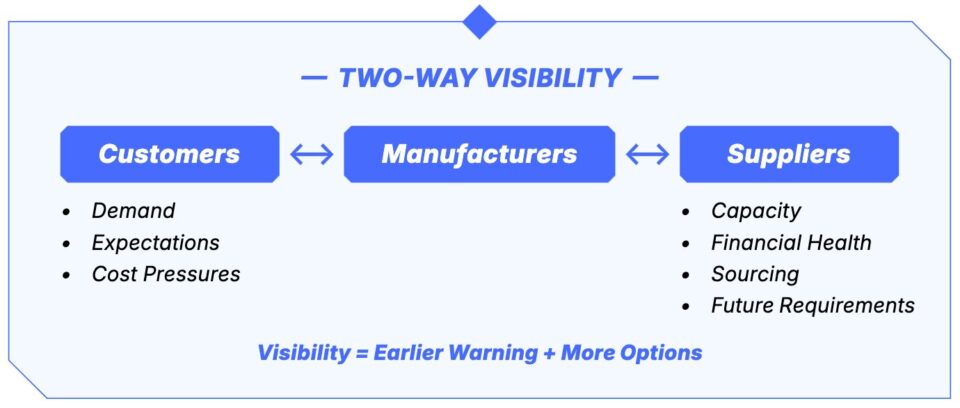
Manufacturers should remain commercially close to their customers to understand changing expectations, demand patterns and cost pressures. At the same time, they need visibility into their suppliers’ capacity, financial health, sourcing strategies and ability to meet future requirements.
That two-way visibility helps manufacturers identify potential problems before they become disruptions. It also creates opportunities.
Open capacity, alternative sourcing options, contract conditions and footprint changes can all become levers for improving the total cost structure without destabilizing the operation.
The manufacturers best positioned to navigate volatility aren’t necessarily those with the perfect forecast. They are the ones with enough visibility and operational discipline to make informed decisions when the forecast changes.
Readiness. Readiness. Readiness.
There is no perfect playbook for today’s manufacturing environment. No organization can accurately predict every market shift or disruption that may emerge over the next six, 12 or 24 months.
Trying to predict every variable is a fool’s errand.
Manufacturers need to build organizations that can absorb uncertainty without constantly changing direction. That means:
This is where experienced operational guidance can make a significant impact.
Turning supply chain pressure into operational opportunity
At Spectrum Management Solutions, we work with manufacturers to understand the operational realities behind the numbers.
We don’t just create strategies that look good on paper. Our approach begins with two fundamental areas: supply chain and cash flow.
We map sourcing, country of origin, total landed cost, supplier relationships and manufacturing footprint to identify where the greatest risks and opportunities exist. We then evaluate cash flow, payment terms, collection terms and other working-capital considerations to understand how operational decisions affect liquidity.
Guided with this forensic data, our experts at Spectrum help manufacturers determine where changes can create sustainable improvements – whether through sourcing, footprint realignment, capacity utilization, purchasing conditions or other operational levers.
We don’t predict the future. We provide the data manufacturers need to truly understand their business and the tools to respond to it.
In a volatile market, that distinction matters. Because effectively weathering the ebbs and flows of uncertainty requires knowing when to change, why to change and how to do it without compromising the fundamentals that keep your business – and your supply chain – moving forward. Not frozen in time.
Spectrum Management Solutions is a manufacturing operations consulting firm that helps automotive OEMs and suppliers improve operational performance, restore profitability and execute transformational change. With more than 110 years of combined automotive-specific experience, Spectrum embeds experienced manufacturing leaders directly into client operations to solve complex challenges, strengthen supply chains and implement sustainable operating systems. Learn more at spectrummanagementsolutions.com.